Sunday, October 11, 2009

Excitement at Shanghai racecourse


This picture shows an exciting finish at the Shanghai Racecourse.

From the straw hats of the spectators on the right, the picture could have been taken in the 1920s, or perhaps a little earlier or later. Shanghai´s residents were fanatical about horse racing and the track was always a popular destination.

The race course site is now the site of the People´s Park.

It is difficult to say with certainty where the picture was taken, but it is possible it was taken from along the line of Nanjing Road, somewhere near where the Radisson Hotel and Pacific Hotels are located.

There is a tower in the distance, which might be that of the Shanghai racing club, but it looks a bit too far away.

If anyone can offer any more information please email me at raxomnium@gmail.com. Click on the picture to enlarge.

***
c. Phillip Bruce

What else lurks in the Mekong?


One of Asia´s mightiest rivers, the Mekong, has revealed some more of its secrets. Floating about on the river and venturing up its creeks in Vietnam recenty there were plenty of strange creatures to see. On muddy banks half-glimpsed things scattered and dashed into holes, crabs, insects, reptiles?

Recently biologists announced that they had identified 163 new species in the Mekong as it passes through Cambodia and Vietnam. This total included 100 new plants, 28 new fish, 18 new reptiles, 14 new amphibians, two mammals and a bird.

For decades, the research of naturalists was hampered or prevented by wars but now they are stepping up their investigations. The effects of defoliants, such as Agent Orange, which were widely sprayed to kill vegetation under which guerillas sheltered are still in evidence.

However, the bigger threat today is probably over-development, with roads, new towns and construction destroying habitat.

No doubt, however, the Mekong still contains surprises yet to be discovered.

***

©Phillip Bruce 2009

How to deal with a snake

British explorers in the 19th century were a tough breed. The Saturday Magazine, of March 8, 1834, recorded how one traveler encountered a snake in South America.

“Waterton, in his Wanderings in South America, gives the following account of his catching a snake. He had sent his Indian servant, Daddy Quashi, to look for something he had lost in the forest, and during his absence, he says, I observed a young Coulacanara, ten feet long, slowly moving onwards, I saw he was not thick enough to break my arm, in case he got twisted round it. There was not a moment to be lost. I laid hold of his tail with the left hand, one knee being on the ground; with the right hand I took off my hat, and held it as you would hold a shield for defence.

“The snake instantly turned, and came on at me, with his head about a yard from the ground, as if to ask me, what business I had to take liberties with his tail. I let him come, hissing and open-mouthed, within two feet of my face, and then, with all the force I was master of, I drove my fist, shielded by my hat, full into his jaws. He was stunned and confounded by the blow, and ere he could recover himself, I had seized his throat with both hands, in such a position that he could not bite me; I then allowed himself to coil himself round my body, and marched off with him as my lawful prize. He pressed me hard, but not alarmingly so.

“In the mean time, Daddy Quashi having returned, and hearing the noise which the fray occasioned, was coming cautiously up. As soon as he saw me, and in what company I was, he turned about and ran off home, I after him, and shouting to increase his fear. On scolding him for his cowardice, the old rogue begged I would forgive him, for the sight of the snake had positively turned him sick.”

Charles Waterton, who was born in 1782, was one of Britain´s great naturalists and spent much of his early life in South America. In 1825 he published his “Wanderings in South America, the North-west of the United States and the Antiles in the years 1812, 1816, 1820 and 1824.” A large octavo edition was published in 1828. The book was very popular. He climbed a tree at his home at Walton Hall, Yorkshire, on his 80th birthday. He died after being injured carrying a log in 1862.

***
©Phillip Bruce 2009

Friday, October 9, 2009

Telling the time in ancient China


To the north of the Forbidden City in Beijing the prominent building known as The Drum Tower can be seen.

The drums inside this building and the bells inside the nearby Bell Tower regulated the day in the Imperial City.

Anyone fit enough for the climb up the steep flight of many steps that rise inside the drum tower can see giant drums which are replicas of those of ancient times. These are regularly beaten for the benefit of visitors. In the silence of the past the sound would have carried for many miles.

However, the drummers needed to know when to beat their drums and that is where an ingenious water clock came in.

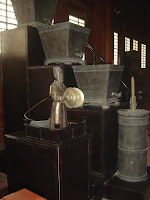
The flowing of water between four different containers allowed time to be measured accurately enough for the purposes of the past.

A replica of the water clock can be seen today. This is referred to as a “Clepsydra,” although the term can’t be found in the Oxford English Dictionary.

There are four bronze water containers. The upper one is known as the Sky Pond, the second as Calm Water, the third as Myriad Parting and the fourth as Water Collecting.

The passage of each quarter of an hour was marked by a small statue of a man with cymbals. A flow of water into the mechanics beneath the figure caused it to clash the symbols together eight times every 15 minutes.

A record of longer periods of time was kept by means of wooden indicators which floated on the water of the lowest tank. Supported by two dragons, the wooden slats were marked with time periods. A store of slats, presumably so that different time periods could be measured, was kept at the side.

The drummers always knew, thanks to the ingenious water clock, when it was time to beat the big drums.

The word "clepsydra" is used to describe a water clock from the Western Han Dynasty (206BC to AD8) which was exhibited in 1998 in Hong Kong at the "Heavenly Creations, Gems of Ancient Chinese Inventions" exhibition This was excavated from a tomb at Mancheng, Hebei in 1968. It is a simple single vertical cylinder with a handled lid at the top and a water outlet at the bottom. The exhibition catalogue explains: "A clepsyrda is an ancient time-measuring device which works by the flow of water. Such water clocks, called "dripping vessels" (louhou) were one type of time-measuring instruments used in ancient China. This particular type came with an indicator called "sinking arrow" (chenjian),inserted through a hole in the handle and the cover. As the water in the vessel dripped through the hole in the bottom, the water level fell and the indicator rod, which was fitted to the float, sank accordingly. The outflow was so adjusted that the marker took a specific time to sink. From graduations on the sinking indicator it was possible to tell the time."

The same exhibition also displayed another clepsydra, from the Yuan Dynasty, cast in 1316. This is similar to the water clock in the drum tower, with four water vessels. The exhibition catalogue states: "Ancient water clocks came in different designs: some consisted of a single vessel, others had multiple vessels. This is the earliest extant example of a multiple vessel design. The four vessels were placed on descending steps of a stepped platform. Water flowed from the sun vessel into the moon vessel, then into the star vessel, finally reaching the water vessel. As the water level rose in the bottom tank, the wooden indicator rose with it, giving a reading of the hour."

***
©www.pbbitsandpieces.com 2009

Saturday, October 3, 2009

What was that name again?

One of the biggest challenges facing anyone visiting China or attempting to understand Chinese history is the various names that refer to the same emperor.

Many Chinese people, official sources and plaques at historic sites, refer to dates by year of the period in which an emperor reigned. This means that foreigners are often confused as they do not carry around dynastic dates tables in their heads.

Matters are further complicated by the fact that emperors are known by a number of different names.

Take the Qing Dynasty of the Manchu emperors who ruled China from 1644 to 1911. Not to be confused with the Qin dynasty, of the first emperor and his terracotta warriors who ruled from 221 BC to 206BC.

The Qing Dynasty was actually founded in 1616 and at first it was known as the Later Jin. The title was changed to Qing in 1644.

As an example of the naming of emperors take the man who ruled from 1875 to 1908.

His family name, like that of all the Qing Emperors, was Aisin Gioro. His personal name was Aisin Gioro Zaitian. However, use of this name was taboo and it was never spoken. A title would be selected for the reign of each emperor, and, in this case, the name chosen was Guanxu. This was used, particularly by foreigners, as if it was his personal name. In China, during his reign he would normally be referred to simply as “His Majesty The Emperor.”

After an emperor died, however, he would be given a name which would be used for ancestral worship rites. The name selected for this emperor was De Zong. Educated Chinese would never use anything other than De Zong in referring to him, with use of Guangxu being regarded as vulgar.

Few foreigners find it easy to cope with all this and many are mystified as they visit the historic sites of China and attempt to understand explanations and signs.

Reading books on Chinese history in English is further complicated by the fact that many use the old Wade-Giles system of writing the sounds of Chinese Characters, rather than the modern Pinyin system, used above.

In Wade-Giles, you will find this emperor's personal name written as Tsai-T'ien (Zaitian). Guanxu is written as Kuang-Hsü. De Zong is written as Té Tsung.

***

©Phillip Bruce.

Thursday, October 1, 2009

Shanghai bridge is back


The old bridge over the Suzhou Creek at Shanghai is back in position after being taken away for a complete restoration and makeover.

The bridge has long been a landmark in Shanghai and now it is again carrying traffic and pedestrians over the Creek.

The photograph shows the bridge in the 1930s, with what is probably a building of the British consulate in the foreground. The Russian Consulate can be seen behind the bridge with the Astor House Hotel across the road.

See also the June 2, 2009, story “Historic Shanghai bridge gets a facelift.”

***

Museum of Chinese in America re-opens

New York´s museum dedicated to the Chinese experience in the United States has re-opened in Chinatown.

The Museum of Chinese in America has benefited from an $8.1 million makeover and it has 1,300 square meters, or 14,000 square feet of space to show its exhibits, videos and interactive displays.

The New York Times commented that the Chinese museum has joined a roster of American museums of identity. “The strange thing is how similar the arcs of their story are: they recount how after a long period of suffering, prejudice and hatred, a group has carved a distinctive place in the history of the United States, its once scorned identity now a source of strength. Many of these museums also serve as anchors for the community and as educational centers, recounting political morality tales and honoring a shared history. That is certainly the case here as well.”

For a slide show on the museum see - http://www.nytimes.com/slideshow/2009/07/08/arts/20090708_CHINESEMUSEUM_SLIDESHOW_index.html

***